
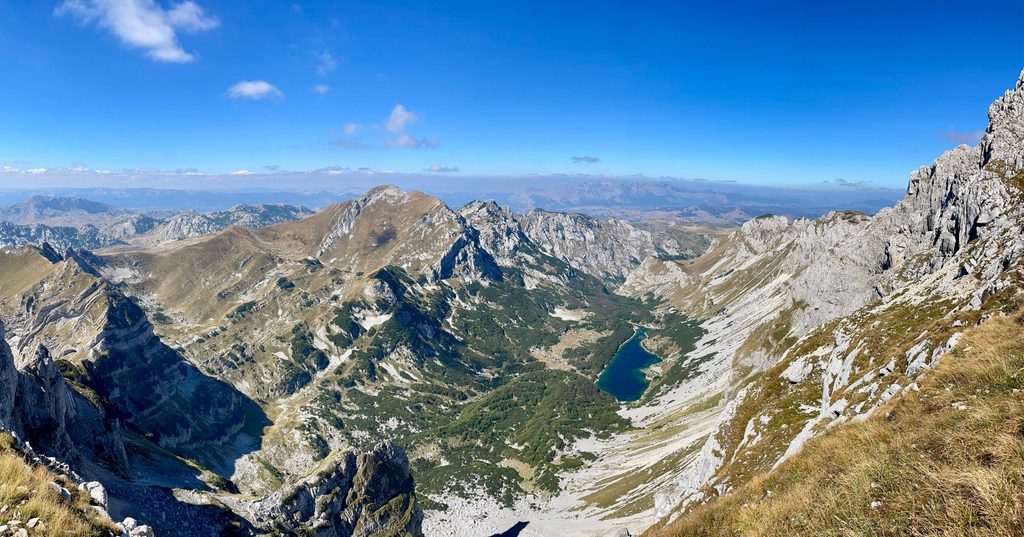
A couple of weeks after announcing my DNS from TOR, I found myself standing at the bottom of Bobotov Kuk in Montenegro, looking at a pretty serious mountain and wondering if I had actually made the wrong decision.
My foot wasn’t broken. I wasn’t limping. I could walk normally. I could hike. I could even run a little.
The tendon on the top of my foot was still sensitive, but it wasn’t screaming at me, and the huge lump that had appeared from the fluid build-up around the tendon sheath had gone down considerably. So naturally, my brain started doing what brains do.
Maybe I could have just done TOR.
This was made slightly more complicated by the messages I started getting from people who had seen me doing short runs, walks and hikes on Strava. To be clear, most of the messages were genuinely lovely and people simply checking in to see how the foot was doing. I really appreciated those.
It was the occasional slightly confused reaction that got into my head more.
“Are you running already?”
And, after I posted a story from Bobotov Kuk:
“WTF? I thought your leg was broken?!”
It wasn’t broken. It was injured. And I think that distinction is actually quite important.
The funny thing is that those comments weren’t really the problem either. Nobody else was responsible for the doubt I started having. They just happened to reinforce something that was already going on in my own head.
Because when you’re suddenly able to walk, hike and do a little running again, it’s very easy to look at what your body can do now and start questioning the decision you made when it couldn’t.
By the time I got to Montenegro, I could comfortably walk for a few hours. I had spent my first week in the Bay of Kotor doing flat walks along the coast in open shoes to avoid aggravating the tendon, exactly as the doctor had advised me to do in Italy.
After around 10 days of that, I could manage a hike/run effort of approximately 90 minutes without feeling pain, although I could still notice the “fluid bump” getting bigger after each outing. So I backed off again.
Another week of flat walks and I felt ready to do some hiking, so I decided to head inland to Žabljak and explore Durmitor National Park.
I ended up hiking Bobotov Kuk and exploring some of the lakes in the area around Žabljak. That’s it. No 8 hour long runs, no big training sessions and no secret comeback.
Just some hiking.
But TOR wasn’t a few hours of hiking.
It was going to be roughly 200 miles over five days, with 24,000m of descent, on technical mountain terrain, carrying a race pack, sleeping very little and asking my body to keep doing it day after day.
Those are two completely different things.
The doctor had told me not to run. I had an angry tendon and obvious fluid build-up around it. The whole reason I didn’t start was because I didn’t want to take something that might have settled relatively quickly and turn it into a problem that kept me out for many months.
That was the decision.
Not because I couldn’t handle the pain. Not because I wasn’t tough enough. And definitely not because I don’t like suffering. I have absolutely no issue with suffering. You don’t enter TOR for the second time if you don’t want to suffer a bit.
The question was simply whether I wanted to risk turning an injury into a much bigger problem for the sake of starting one race.
No. Obviously no.
And yet, standing on a mountain a few weeks later with a foot that was behaving itself, I still found myself questioning it.
That’s the weird bit about injuries. You can make what feels like the correct decision based on the information you have at the time, and then later, when you feel better, your brain conveniently forgets how unhappy that tendon actually was.
There is a difference between a niggle and an injury. This is something I talk about with my athletes all the time. Ultrarunning involves discomfort. You’re going to have tired legs. You’re going to have sore muscles. You’re occasionally going to wake up feeling like you’ve been hit by a truck after a big training weekend. Sometimes you’ve got a little niggle that settles as you warm up. Sometimes you’re tired and you train anyway. That’s normal every now and then. But there is a very big difference between training through normal training discomfort and knowingly loading an injured structure because you’ve decided the race matters more.
Especially when the event you’re about to do is an enormous physical load. If I’d had a slightly tight calf before TOR, I’d probably have managed it. A pissed off tendon with a visible lump on the top of my foot was a different conversation. And I think this is where the whole “hardcore” mentality can become a bit misleading. There is nothing particularly hardcore about taking an injury and making it significantly worse because you really, really want to start a race. You don’t get extra points for that.
You just potentially get a much longer rehabilitation period.
But knowing all of that doesn’t make the DNS feel good. This is the part that I don’t think gets talked about enough. Knowing you’ve made the sensible decision doesn’t mean you’re automatically at peace with it. I told myself I was, but I wasn’t 100%. I had planned an entire European trip around TOR. Months and months of training had gone into it. Travel, accommodation, race entry, flights, time, money (so much money) and energy. I had built a huge chunk of my year around getting myself to that start line. And then suddenly, I wasn’t going.
I think part of what made it difficult was seeing what I could do afterwards and comparing it with what I had decided I couldn’t do. I could hike, I could walk. and I could do little runs.
So my brain kept going: See? You could have started. But that’s hindsight.
At the time, I had to make a decision based on the information I actually had.
So I went to Montenegro. Partly because it was cheaper to be there than to stay in Italy, and partly because I thought having a total change of scenery would help me process things. Going straight home wasn’t really an option either, as I had family commitments later in September and October, so I needed to stay in Europe for a while anyway. Montenegro suddenly made quite a lot of sense. And that’s how I ended up in Žabljak, with the Durmitor mountains on my doorstep and a foot that was slowly starting to behave itself.
A different kind of mountain day
Honestly, I’m very glad I went. It wasn’t TOR. It wasn’t remotely TOR, and I doubt anywhere will ever quite live up to TOR for me. But it was still a spectacular mountain day, and being out there reminded me that the mountains don’t actually care what race you’ve entered. There was no finish line, no race number, no cut-offs, no aid stations and no 200-mile adventure waiting for me at the top. Just a mountain, a few hours on my feet and a whole lot of time to think. And, annoyingly, quite a lot of time to think about whether I should have been at TOR.
I think that’s probably the part of this whole thing I’m still working through.
I’m completely comfortable saying that DNS’ing was the sensible decision. I’m much less comfortable admitting that I’m still disappointed about it. Both things can be true.
Was all that preparation wasted?
This is probably the other thing I’ve had to keep reminding myself. The training wasn’t wasted. The months of work weren’t wasted. The money wasn’t magically wasted because I didn’t start. The time wasn’t wasted.
I learned a huge amount during that preparation. I got fitter. I got stronger. I spent months doing exactly what I love doing, spending long days in the mountains and preparing for something ridiculously difficult.
And then the goal disappeared.
That doesn’t make all of that work meaningless. It just means the outcome wasn’t the one I wanted. I think that’s something a lot of runners can relate to. We tend to look at training as being valuable only if it produces the result we were aiming for: a PB, a finish, a qualification, a buckle. But training doesn’t suddenly become worthless because the race doesn’t happen. Sometimes the goal changes.
And sometimes you have to find a way to make the work you’ve already done mean something beyond the finish line you were originally chasing.
Truth is, I’m probably going to be disappointed about missing TOR for a while. But I’d rather deal with that than spend the next six months trying to fix a foot that I knowingly wrecked because I couldn’t bring myself to stay home.
And that’s probably the most honest version of the whole story.
I didn’t DNS because I suddenly became sensible and emotionally mature about ultrarunning. I DNS’d because, at that point, I knew what the sensible decision was. Then I spent the next few weeks occasionally wondering if I’d fucked it up anyway.
But I suppose that’s part of doing anything you are genuinely passionate about and care deeply about. When you’ve invested so much of yourself into something, it’s hard to simply shrug and move on when it doesn’t go the way you planned.
Sometimes the hard part isn’t getting yourself to the start line. Sometimes it’s having the discipline not to.
Leave a Reply